

SSCP 試験問題 556
What is called the formal acceptance of the adequacy of a system's overall security by the management?
正解: C
Explanation/Reference:
Accreditation is the authorization by management to implement software or systems in a production environment. This authorization may be either provisional or full.
The following are incorrect answers:
Certification is incorrect. Certification is the process of evaluating the security stance of the software or system against a selected set of standards or policies. Certification is the technical evaluation of a product. This may precede accreditation but is not a required precursor.
Acceptance is incorrect. This term is sometimes used as the recognition that a piece of software or system has met a set of functional or service level criteria (the new payroll system has passed its acceptance test).
Certification is the better tem in this context.
Evaluation is incorrect. Evaluation is certainly a part of the certification process but it is not the best answer to the question.
Reference(s) used for this question:
The Official Study Guide to the CBK from ISC2, pages 559-560
AIO3, pp. 314 - 317
AIOv4 Security Architecture and Design (pages 369 - 372)
AIOv5 Security Architecture and Design (pages 370 - 372)
Accreditation is the authorization by management to implement software or systems in a production environment. This authorization may be either provisional or full.
The following are incorrect answers:
Certification is incorrect. Certification is the process of evaluating the security stance of the software or system against a selected set of standards or policies. Certification is the technical evaluation of a product. This may precede accreditation but is not a required precursor.
Acceptance is incorrect. This term is sometimes used as the recognition that a piece of software or system has met a set of functional or service level criteria (the new payroll system has passed its acceptance test).
Certification is the better tem in this context.
Evaluation is incorrect. Evaluation is certainly a part of the certification process but it is not the best answer to the question.
Reference(s) used for this question:
The Official Study Guide to the CBK from ISC2, pages 559-560
AIO3, pp. 314 - 317
AIOv4 Security Architecture and Design (pages 369 - 372)
AIOv5 Security Architecture and Design (pages 370 - 372)
SSCP 試験問題 557
An Architecture where there are more than two execution domains or privilege levels is called:
正解: A
In computer science, hierarchical protection domains, often called protection rings, are a mechanism to protect data and functionality from faults (fault tolerance) and malicious behavior (computer security). This approach is diametrically opposite to that of capability-based security.
Computer operating systems provide different levels of access to resources. A protection ring is one of two or more hierarchical levels or layers of privilege within the architecture of a computer system. This is generally hardware-enforced by some CPU architectures that provide different CPU modes at the hardware or microcode level. Rings are arranged in a hierarchy from most privileged (most trusted, usually numbered zero) to least privileged (least trusted, usually with the highest ring number). On most operating systems, Ring 0 is the level with the most privileges and interacts most directly with the physical hardware such as the CPU and memory.
Special gates between rings are provided to allow an outer ring to access an inner ring's resources in a predefined manner, as opposed to allowing arbitrary usage. Correctly gating access between rings can improve security by preventing programs from one ring or privilege level from misusing resources intended for programs in another. For example, spyware running as a user program in Ring 3 should be prevented from turning on a web camera without informing the user, since hardware access should be a Ring 1 function reserved for device drivers. Programs such as web browsers running in higher numbered rings must request access to the network, a resource restricted to a lower numbered ring. Ring Architecture Ring Architecture
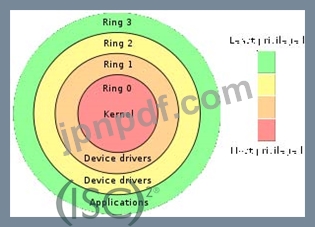
All of the other answers are incorrect because they are detractors.
References:
OIG CBK Security Architecture and Models (page 311) and https://en.wikipedia.org/wiki/Ring_%28computer_security%29
Computer operating systems provide different levels of access to resources. A protection ring is one of two or more hierarchical levels or layers of privilege within the architecture of a computer system. This is generally hardware-enforced by some CPU architectures that provide different CPU modes at the hardware or microcode level. Rings are arranged in a hierarchy from most privileged (most trusted, usually numbered zero) to least privileged (least trusted, usually with the highest ring number). On most operating systems, Ring 0 is the level with the most privileges and interacts most directly with the physical hardware such as the CPU and memory.
Special gates between rings are provided to allow an outer ring to access an inner ring's resources in a predefined manner, as opposed to allowing arbitrary usage. Correctly gating access between rings can improve security by preventing programs from one ring or privilege level from misusing resources intended for programs in another. For example, spyware running as a user program in Ring 3 should be prevented from turning on a web camera without informing the user, since hardware access should be a Ring 1 function reserved for device drivers. Programs such as web browsers running in higher numbered rings must request access to the network, a resource restricted to a lower numbered ring. Ring Architecture Ring Architecture
All of the other answers are incorrect because they are detractors.
References:
OIG CBK Security Architecture and Models (page 311) and https://en.wikipedia.org/wiki/Ring_%28computer_security%29
SSCP 試験問題 558
What setup should an administrator use for regularly testing the strength of user passwords?
正解: C
Section: Analysis and Monitoring
Explanation/Reference:
Poor password selection is frequently a major security problem for any system's security. Administrators should obtain and use password-guessing programs frequently to identify those users having easily guessed passwords.
Because password-cracking programs are very CPU intensive and can slow the system on which it is running, it is a good idea to transfer the encrypted passwords to a standalone (not networked) workstation. Also, by doing the work on a non-networked machine, any results found will not be accessible by anyone unless they have physical access to that system.
Out of the four choice presented above this is the best choice.
However, in real life you would have strong password policies that enforce complexity requirements and does not let the user choose a simple or short password that can be easily cracked or guessed. That would be the best choice if it was one of the choice presented.
Another issue with password cracking is one of privacy. Many password cracking tools can avoid this by only showing the password was cracked and not showing what the password actually is. It is masking the password being used from the person doing the cracking.
Source: National Security Agency, Systems and Network Attack Center (SNAC), The 60 Minute Network Security Guide, February 2002, page 8.
Explanation/Reference:
Poor password selection is frequently a major security problem for any system's security. Administrators should obtain and use password-guessing programs frequently to identify those users having easily guessed passwords.
Because password-cracking programs are very CPU intensive and can slow the system on which it is running, it is a good idea to transfer the encrypted passwords to a standalone (not networked) workstation. Also, by doing the work on a non-networked machine, any results found will not be accessible by anyone unless they have physical access to that system.
Out of the four choice presented above this is the best choice.
However, in real life you would have strong password policies that enforce complexity requirements and does not let the user choose a simple or short password that can be easily cracked or guessed. That would be the best choice if it was one of the choice presented.
Another issue with password cracking is one of privacy. Many password cracking tools can avoid this by only showing the password was cracked and not showing what the password actually is. It is masking the password being used from the person doing the cracking.
Source: National Security Agency, Systems and Network Attack Center (SNAC), The 60 Minute Network Security Guide, February 2002, page 8.
SSCP 試験問題 559
Secure Shell (SSH-2) provides all the following services except:
正解: D
Explanation/Reference:
This is one of the tricky negative question. You have to pay close attention to the word EXCEPT within the question.
The SSH transport layer is a secure, low level transport protocol. It provides strong encryption, cryptographic host authentication, and integrity protection.
Authentication in this protocol level is host-based; this protocol does not perform user authentication. A higher level protocol for user authentication can be designed on top of this protocol.
The protocol has been designed to be simple and flexible to allow parameter negotiation, and to minimize the number of round-trips. The key exchange method, public key algorithm, symmetric encryption algorithm, message authentication algorithm, and hash algorithm are all negotiated. It is expected that in most environments, only 2 round-trips will be needed for full key exchange, server authentication, service request, and acceptance notification of service request. The worst case is 3 round- trips.
The following are incorrect answers:
"Remote log-on" is incorrect. SSH does provide remote log-on.
"Command execution" is incorrect. SSH does provide command execution.
"Port forwarding" is incorrect. SSH does provide port forwarding. SSH also has a wonderful feature called SSH Port Forwarding, sometimes called SSH Tunneling, which allows you to establish a secure SSH session and then tunnel arbitrary TCP connections through it. Tunnels can be created at any time, with almost no effort and no programming, which makes them very appealing. See the article below in the reference to take a look at SSH Port Forwarding in detail, as it is a very useful but often misunderstood technology. SSH Port Forwarding can be used for secure communications in a myriad of different ways.
You can see a nice tutorial on the PUTTY web site on how to use PUTTY to do port forwarding at:
http://www.cs.uu.nl/technical/services/ssh/putty/puttyfw.html
Reference(s) used for this question:
RFC 4253 at https://www.ietf.org/rfc/rfc4253.txt
and
SSH Port Forwarding by Symantec
This is one of the tricky negative question. You have to pay close attention to the word EXCEPT within the question.
The SSH transport layer is a secure, low level transport protocol. It provides strong encryption, cryptographic host authentication, and integrity protection.
Authentication in this protocol level is host-based; this protocol does not perform user authentication. A higher level protocol for user authentication can be designed on top of this protocol.
The protocol has been designed to be simple and flexible to allow parameter negotiation, and to minimize the number of round-trips. The key exchange method, public key algorithm, symmetric encryption algorithm, message authentication algorithm, and hash algorithm are all negotiated. It is expected that in most environments, only 2 round-trips will be needed for full key exchange, server authentication, service request, and acceptance notification of service request. The worst case is 3 round- trips.
The following are incorrect answers:
"Remote log-on" is incorrect. SSH does provide remote log-on.
"Command execution" is incorrect. SSH does provide command execution.
"Port forwarding" is incorrect. SSH does provide port forwarding. SSH also has a wonderful feature called SSH Port Forwarding, sometimes called SSH Tunneling, which allows you to establish a secure SSH session and then tunnel arbitrary TCP connections through it. Tunnels can be created at any time, with almost no effort and no programming, which makes them very appealing. See the article below in the reference to take a look at SSH Port Forwarding in detail, as it is a very useful but often misunderstood technology. SSH Port Forwarding can be used for secure communications in a myriad of different ways.
You can see a nice tutorial on the PUTTY web site on how to use PUTTY to do port forwarding at:
http://www.cs.uu.nl/technical/services/ssh/putty/puttyfw.html
Reference(s) used for this question:
RFC 4253 at https://www.ietf.org/rfc/rfc4253.txt
and
SSH Port Forwarding by Symantec
SSCP 試験問題 560
Which of the following division is defined in the TCSEC (Orange Book) as minimal protection?
正解: A
Explanation/Reference:
The criteria are divided into four divisions: D, C, B, and A ordered in a hierarchical manner with the highest division (A) being reserved for systems providing the most comprehensive security.
Each division represents a major improvement in the overall confidence one can place in the system for the protection of sensitive information.
Within divisions C and B there are a number of subdivisions known as classes. The classes are also ordered in a hierarchical manner with systems representative of division C and lower classes of division B being characterized by the set of computer security mechanisms that they possess.
Assurance of correct and complete design and implementation for these systems is gained mostly through testing of the security- relevant portions of the system. The security-relevant portions of a system are referred to throughout this document as the Trusted Computing Base (TCB).
Systems representative of higher classes in division B and division A derive their security attributes more from their design and implementation structure. Increased assurance that the required features are operative, correct, and tamperproof under all circumstances is gained through progressively more rigorous analysis during the design process.
TCSEC provides a classification system that is divided into hierarchical divisions of assurance levels:
Division D - minimal security
Division C - discretionary protection
Division B - mandatory protection
Division A - verified protection
Reference: page 358 AIO V.5 Shon Harris
also
Source: KRUTZ, Ronald L. & VINES, Russel D., The CISSP Prep Guide: Mastering the Ten Domains of Computer Security, page 197.
Also:
THE source for all TCSEC "level" questions: http://csrc.nist.gov/publications/secpubs/rainbow/std001.txt
The criteria are divided into four divisions: D, C, B, and A ordered in a hierarchical manner with the highest division (A) being reserved for systems providing the most comprehensive security.
Each division represents a major improvement in the overall confidence one can place in the system for the protection of sensitive information.
Within divisions C and B there are a number of subdivisions known as classes. The classes are also ordered in a hierarchical manner with systems representative of division C and lower classes of division B being characterized by the set of computer security mechanisms that they possess.
Assurance of correct and complete design and implementation for these systems is gained mostly through testing of the security- relevant portions of the system. The security-relevant portions of a system are referred to throughout this document as the Trusted Computing Base (TCB).
Systems representative of higher classes in division B and division A derive their security attributes more from their design and implementation structure. Increased assurance that the required features are operative, correct, and tamperproof under all circumstances is gained through progressively more rigorous analysis during the design process.
TCSEC provides a classification system that is divided into hierarchical divisions of assurance levels:
Division D - minimal security
Division C - discretionary protection
Division B - mandatory protection
Division A - verified protection
Reference: page 358 AIO V.5 Shon Harris
also
Source: KRUTZ, Ronald L. & VINES, Russel D., The CISSP Prep Guide: Mastering the Ten Domains of Computer Security, page 197.
Also:
THE source for all TCSEC "level" questions: http://csrc.nist.gov/publications/secpubs/rainbow/std001.txt

SSCP プレミアム問題集
365日無料更新
専門家プレゼンツ
1338 問題と解答
Windows / Mac / Android / iOS などをサポート
最新 ISC SSCP 試験問題集は GoShiken.com のサポートで SSCP 試験を合格させます!
(40%OFF 特別割引: JPNPDF)
- 最新アップロード
- 107APEGS.NPPE.v2026-09-03.q79
- 108ASIS.ASIS-PSP.v2026-09-03.q195
- 107Microsoft.GH-300.v2026-09-03.q70
- 140Salesforce.AP-208.v2026-09-02.q62
- 163Fortinet.NSE7_FSN_AR-7.6.v2026-09-02.q99
- 134SAP.C_P2WBW_2505.v2026-09-01.q28
- 128HP.HPE0-J81.v2026-09-01.q17
- 153F5.402.v2026-09-01.q52
- 174Lpi.304-200.v2026-08-31.q125
- 134EMC.D-SNC-DY-00.v2026-08-31.q15