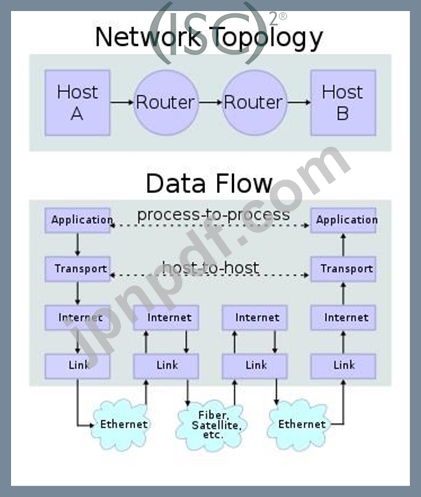
Which of the following DoD Model layer provides non-repudiation services?
正解: B
Explanation/Reference: The Application Layer determines the identity of the communication partners and this is where Non- Repudiation service would be provided as well. See the layers below: DOD Model DoD Model The following answers are incorrect: network layer. Is incorrect because the Network Layer mostly has routing protocols, ICMP, IP, and IPSEC. It it not a layer in the DoD Model. It is called the Internet Layer within the DoD model. transport layer. Is incorrect because the Transport layer provides transparent transfer of data between end users. This is called Host-to-Host on the DoD model but sometimes some books will call it Transport as well on the DoD model. data link layer. Is incorrect because the Data Link Layer defines the protocols that computers must follow to access the network for transmitting and receiving messages. It is part of the OSI Model. This does not exist on the DoD model, it is called the Link Layer on the DoD model.
SSCP 試験問題 472
Which of the following is an IP address that is private (i.e. reserved for internal networks, and not a valid address to use on the Internet)?
正解: A
Section: Network and Telecommunications Explanation/Reference: This is a valid Class C reserved address. For Class C, the reserved addresses are 192.168.0.0 - 192.168.255.255. The private IP address ranges are defined within RFC 1918: RFC 1918 private ip address range The following answers are incorrect: 192.166.42.5 Is incorrect because it is not a Class C reserved address. 192.175.42.5 Is incorrect because it is not a Class C reserved address. 192.1.42.5 Is incorrect because it is not a Class C reserved address.
SSCP 試験問題 473
Which of the following best describes what would be expected at a "hot site"?
正解: A
Section: Risk, Response and Recovery Explanation/Reference: A Hot Site contains everything needed to become operational in the shortest amount of time. The following answers are incorrect: Computers and peripherals. Is incorrect because no mention is made of cables. You would not be fully operational without those. Computers and dedicated climate control systems. Is incorrect because no mention is made of peripherals. You would not be fully operational without those. Dedicated climate control systems. Is incorrect because no mentionis made of computers, cables and peripherals. You would not be fully operational without those. According to the OIG, a hot site is defined as a fully configured site with complete customer required hardware and software provided by the service provider. A hot site in the context of the CBK is always a RENTAL place. If you have your own site fully equipped that you make use of in case of disaster that would be called a redundant site or an alternate site. Wikipedia: "A hot site is a duplicate of the original site of the organization, with full computer systems as well as near-complete backups of user data." References: OIG CBK, Business Continuity and Disaster Recovery Planning (pages 367 - 368) AIO, 3rd Edition, Business Continuity Planning (pages 709 - 714) AIO, 4th Edition, Business Continuity Planning , p 790. Wikipedia - http://en.wikipedia.org/wiki/Hot_site#Hot_Sites
SSCP 試験問題 474
Which of the following is an Internet IPsec protocol to negotiate, establish, modify, and delete security associations, and to exchange key generation and authentication data, independent of the details of any specific key generation technique, key establishment protocol, encryption algorithm, or authentication mechanism?
正解: B
Section: Cryptography Explanation/Reference: RFC 2828 (Internet Security Glossary) defines the Internet Security Association and Key Management Protocol (ISAKMP) as an Internet IPsec protocol to negotiate, establish, modify, and delete security associations, and to exchange key generation and authentication data, independent of the details of any specific key generation technique, key establishment protocol, encryption algorithm, or authentication mechanism. Let's clear up some confusion here first. Internet Key Exchange (IKE) is a hybrid protocol, it consists of 3 "protocols" ISAKMP: It's not a key exchange protocol per se, it's a framework on which key exchange protocols operate. ISAKMP is part of IKE. IKE establishs the shared security policy and authenticated keys. ISAKMP is the protocol that specifies the mechanics of the key exchange. Oakley: Describes the "modes" of key exchange (e.g. perfect forward secrecy for keys, identity protection, and authentication). Oakley describes a series of key exchanges and services. SKEME: Provides support for public-key-based key exchange, key distribution centres, and manual installation, it also outlines methods of secure and fast key refreshment. So yes, IPSec does use IKE, but ISAKMP is part of IKE. The questions did not ask for the actual key negotiation being done but only for the "exchange of key generation and authentication data" being done. Under Oakly it would be Diffie Hellman (DH) that would be used for the actual key nogotiation. The following are incorrect answers: Simple Key-management for Internet Protocols (SKIP) is a key distribution protocol that uses hybrid encryption to convey session keys that are used to encrypt data in IP packets. OAKLEY is a key establishment protocol (proposed for IPsec but superseded by IKE) based on the Diffie- Hellman algorithm and designed to be a compatible component of ISAKMP. IPsec Key Exchange (IKE) is an Internet, IPsec, key-establishment protocol [R2409] (partly based on OAKLEY) that is intended for putting in place authenticated keying material for use with ISAKMP and for other security associations, such as in AH and ESP. Reference used for this question: SHIREY, Robert W., RFC2828: Internet Security Glossary, may 2000.
SSCP 試験問題 475
Which of the following is best defined as an administrative declaration by a designated authority that an information system is approved to operate in a particular security configuration with a prescribed set of safeguards?
正解: D
Section: Security Operation Adimnistration Explanation/Reference: Accreditation: is an administrative declaration by a designated authority that an information system is approved to operate in a particular security configuration with a prescribed set of safeguards. It is usually based on a technical certification of the system's security mechanisms. Certification: Technical evaluation (usually made in support of an accreditation action) of an information system \'s security features and other safeguards to establish the extent to which the system\'s design and implementation meet specified security requirements. Source: SHIREY, Robert W., RFC2828: Internet Security Glossary, may 2000.