

SSCP 試験問題 491
Which of the following should be emphasized during the Business Impact Analysis (BIA) considering that the BIA focus is on business processes?
正解: C
Explanation/Reference:
The Business Impact Analysis (BIA) identifies time-critical aspects of the critical business processes, and determines their maximum tolerable downtime. The BIA helps to Identify organization functions, the capabilities of each organization unit to handle outages, and the priority and sequence of functions and applications to be recovered, identify resources required for recovery of those areas and interdependencies
In performing the Business Impact Analysis (BIA) it is very important to consider what the dependencies are. You cannot bring a system up if it depends on another system to be operational. You need to look at not only internal dependencies but external as well. You might not be able to get the raw materials for your business so dependencies are very important aspect of a BIA.
The BIA committee will not truly understand all business processes, the steps that must take place, or the resources and supplies these processes require. So the committee must gather this information from the people who do know- department managers and specific employees throughout the organization. The committee starts by identifying the people who will be part of the BIA data-gathering sessions. The committee needs to identify how it will collect the data from the selected employees, be it through surveys, interviews, or workshops. Next, the team needs to collect the information by actually conducting surveys, interviews, and workshops. Data points obtained as part of the information gathering will be used later during analysis. It is important that the team members ask about how different tasks- whether processes, transactions, or services, along with any relevant dependencies- get accomplished within the organization.
The following answers are incorrect:
composition This is incorrect because it is not the best answer. While the make up of business may be important, if you have not determined the dependencies first you may not be able to bring the critical business processes to a ready state or have the materials on hand that are needed.
priorities This is incorrect because it is not the best answer. While the priorities of processes are important, if you have not determined the dependencies first you may not be able to bring the critical business processes to a ready state or have the materials on hand that are needed.
service levels This is incorrect because it is not the best answer. Service levels are not as important as dependencies.
Reference(s) used for this question:
Schneiter, Andrew (2013-04-15). Official (ISC)2 Guide to the CISSP CBK, Third Edition : Business Continuity and Disaster Recovery Planning (Kindle Locations 188-191). . Kindle Edition.
and
Harris, Shon (2012-10-25). CISSP All-in-One Exam Guide, 6th Edition (Kindle Locations 18562-18568).
McGraw-Hill. Kindle Edition.
The Business Impact Analysis (BIA) identifies time-critical aspects of the critical business processes, and determines their maximum tolerable downtime. The BIA helps to Identify organization functions, the capabilities of each organization unit to handle outages, and the priority and sequence of functions and applications to be recovered, identify resources required for recovery of those areas and interdependencies
In performing the Business Impact Analysis (BIA) it is very important to consider what the dependencies are. You cannot bring a system up if it depends on another system to be operational. You need to look at not only internal dependencies but external as well. You might not be able to get the raw materials for your business so dependencies are very important aspect of a BIA.
The BIA committee will not truly understand all business processes, the steps that must take place, or the resources and supplies these processes require. So the committee must gather this information from the people who do know- department managers and specific employees throughout the organization. The committee starts by identifying the people who will be part of the BIA data-gathering sessions. The committee needs to identify how it will collect the data from the selected employees, be it through surveys, interviews, or workshops. Next, the team needs to collect the information by actually conducting surveys, interviews, and workshops. Data points obtained as part of the information gathering will be used later during analysis. It is important that the team members ask about how different tasks- whether processes, transactions, or services, along with any relevant dependencies- get accomplished within the organization.
The following answers are incorrect:
composition This is incorrect because it is not the best answer. While the make up of business may be important, if you have not determined the dependencies first you may not be able to bring the critical business processes to a ready state or have the materials on hand that are needed.
priorities This is incorrect because it is not the best answer. While the priorities of processes are important, if you have not determined the dependencies first you may not be able to bring the critical business processes to a ready state or have the materials on hand that are needed.
service levels This is incorrect because it is not the best answer. Service levels are not as important as dependencies.
Reference(s) used for this question:
Schneiter, Andrew (2013-04-15). Official (ISC)2 Guide to the CISSP CBK, Third Edition : Business Continuity and Disaster Recovery Planning (Kindle Locations 188-191). . Kindle Edition.
and
Harris, Shon (2012-10-25). CISSP All-in-One Exam Guide, 6th Edition (Kindle Locations 18562-18568).
McGraw-Hill. Kindle Edition.
SSCP 試験問題 492
Which of the following is NOT a characteristic of a host-based intrusion detection system?
正解: A
A HIDS does not consume large amounts of system resources is the correct choice. HIDS can consume inordinate amounts of CPU and system resources in order to function effectively, especially during an event.
All the other answers are characteristics of HIDSes
A HIDS can:
scrutinize event logs, critical system files, and other auditable system resources; look for unauthorized change or suspicious patterns of behavior or activity can send alerts when unusual events are discovered
Reference:
Official guide to the CISSP CBK. Pages 197 to 198.
All the other answers are characteristics of HIDSes
A HIDS can:
scrutinize event logs, critical system files, and other auditable system resources; look for unauthorized change or suspicious patterns of behavior or activity can send alerts when unusual events are discovered
Reference:
Official guide to the CISSP CBK. Pages 197 to 198.
SSCP 試験問題 493
Almost all types of detection permit a system's sensitivity to be increased or decreased during an inspection process. If the system's sensitivity is increased, such as in a biometric authentication system, the system becomes increasingly selective and has the possibility of generating:
正解: B
Explanation/Reference:
Almost all types of detection permit a system's sensitivity to be increased or decreased during an inspection process. If the system's sensitivity is increased, such as in a biometric authentication system, the system becomes increasingly selective and has a higher False Rejection Rate (FRR).
Conversely, if the sensitivity is decreased, the False Acceptance Rate (FRR) will increase. Thus, to have a valid measure of the system performance, the Cross Over Error (CER) rate is used. The Crossover Error Rate (CER) is the point at which the false rejection rates and the false acceptance rates are equal. The lower the value of the CER, the more accurate the system.
There are three categories of biometric accuracy measurement (all represented as percentages):
False Reject Rate (a Type I Error): When authorized users are falsely rejected as unidentified or unverified.
False Accept Rate (a Type II Error): When unauthorized persons or imposters are falsely accepted as authentic.
Crossover Error Rate (CER): The point at which the false rejection rates and the false acceptance rates are equal. The smaller the value of the CER, the more accurate the system.
NOTE:
Within the ISC2 book they make use of the term Accept or Acceptance and also Reject or Rejection when referring to the type of errors within biometrics. Below we make use of Acceptance and Rejection throughout the text for conistency. However, on the real exam you could see either of the terms.
Performance of biometrics
Different metrics can be used to rate the performance of a biometric factor, solution or application. The most common performance metrics are the False Acceptance Rate FAR and the False Rejection Rate FRR.
When using a biometric application for the first time the user needs to enroll to the system. The system requests fingerprints, a voice recording or another biometric factor from the operator, this input is registered in the database as a template which is linked internally to a user ID. The next time when the user wants to authenticate or identify himself, the biometric input provided by the user is compared to the template(s) in the database by a matching algorithm which responds with acceptance (match) or rejection (no match).
FAR and FRR
The FAR or False Acceptance rate is the probability that the system incorrectly authorizes a non- authorized person, due to incorrectly matching the biometric input with a valid template. The FAR is normally expressed as a percentage, following the FAR definition this is the percentage of invalid inputs which are incorrectly accepted.
The FRR or False Rejection Rate is the probability that the system incorrectly rejects access to an authorized person, due to failing to match the biometric input provided by the user with a stored template.
The FRR is normally expressed as a percentage, following the FRR definition this is the percentage of valid inputs which are incorrectly rejected.
FAR and FRR are very much dependent on the biometric factor that is used and on the technical implementation of the biometric solution. Furthermore the FRR is strongly person dependent, a personal FRR can be determined for each individual.
Take this into account when determining the FRR of a biometric solution, one person is insufficient to establish an overall FRR for a solution. Also FRR might increase due to environmental conditions or incorrect use, for example when using dirty fingers on a fingerprint reader. Mostly the FRR lowers when a user gains more experience in how to use the biometric device or software.
FAR and FRR are key metrics for biometric solutions, some biometric devices or software even allow to tune them so that the system more quickly matches or rejects. Both FRR and FAR are important, but for most applications one of them is considered most important. Two examples to illustrate this:
When biometrics are used for logical or physical access control, the objective of the application is to disallow access to unauthorized individuals under all circumstances. It is clear that a very low FAR is needed for such an application, even if it comes at the price of a higher FRR.
When surveillance cameras are used to screen a crowd of people for missing children, the objective of the application is to identify any missing children that come up on the screen. When the identification of those children is automated using a face recognition software, this software has to be set up with a low FRR. As such a higher number of matches will be false positives, but these can be reviewed quickly by surveillance personnel.
False Acceptance Rate is also called False Match Rate, and False Rejection Rate is sometimes referred to as False Non-Match Rate.
crossover error rate
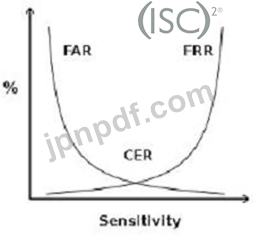
Above see a graphical representation of FAR and FRR errors on a graph, indicating the CER CER
The Crossover Error Rate or CER is illustrated on the graph above. It is the rate where both FAR and FRR are equal.
The matching algorithm in a biometric software or device uses a (configurable) threshold which determines how close to a template the input must be for it to be considered a match. This threshold value is in some cases referred to as sensitivity, it is marked on the X axis of the plot. When you reduce this threshold there will be more false acceptance errors (higher FAR) and less false rejection errors (lower FRR), a higher threshold will lead to lower FAR and higher FRR.
Speed
Most manufacturers of biometric devices and softwares can give clear numbers on the time it takes to enroll as well on the time for an individual to be authenticated or identified using their application. If speed is important then take your time to consider this, 5 seconds might seem a short time on paper or when testing a device but if hundreds of people will use the device multiple times a day the cumulative loss of time might be significant.
Reference(s) used for this question:
Hernandez CISSP, Steven (2012-12-21). Official (ISC)2 Guide to the CISSP CBK, Third Edition ((ISC)2 Press) (Kindle Locations 2723-2731). Auerbach Publications. Kindle Edition.
and
KRUTZ, Ronald L. & VINES, Russel D., The CISSP Prep Guide: Mastering the Ten Domains of Computer Security, 2001, John Wiley & Sons, Page 37.
and
http://www.biometric-solutions.com/index.php?story=performance_biometrics
Almost all types of detection permit a system's sensitivity to be increased or decreased during an inspection process. If the system's sensitivity is increased, such as in a biometric authentication system, the system becomes increasingly selective and has a higher False Rejection Rate (FRR).
Conversely, if the sensitivity is decreased, the False Acceptance Rate (FRR) will increase. Thus, to have a valid measure of the system performance, the Cross Over Error (CER) rate is used. The Crossover Error Rate (CER) is the point at which the false rejection rates and the false acceptance rates are equal. The lower the value of the CER, the more accurate the system.
There are three categories of biometric accuracy measurement (all represented as percentages):
False Reject Rate (a Type I Error): When authorized users are falsely rejected as unidentified or unverified.
False Accept Rate (a Type II Error): When unauthorized persons or imposters are falsely accepted as authentic.
Crossover Error Rate (CER): The point at which the false rejection rates and the false acceptance rates are equal. The smaller the value of the CER, the more accurate the system.
NOTE:
Within the ISC2 book they make use of the term Accept or Acceptance and also Reject or Rejection when referring to the type of errors within biometrics. Below we make use of Acceptance and Rejection throughout the text for conistency. However, on the real exam you could see either of the terms.
Performance of biometrics
Different metrics can be used to rate the performance of a biometric factor, solution or application. The most common performance metrics are the False Acceptance Rate FAR and the False Rejection Rate FRR.
When using a biometric application for the first time the user needs to enroll to the system. The system requests fingerprints, a voice recording or another biometric factor from the operator, this input is registered in the database as a template which is linked internally to a user ID. The next time when the user wants to authenticate or identify himself, the biometric input provided by the user is compared to the template(s) in the database by a matching algorithm which responds with acceptance (match) or rejection (no match).
FAR and FRR
The FAR or False Acceptance rate is the probability that the system incorrectly authorizes a non- authorized person, due to incorrectly matching the biometric input with a valid template. The FAR is normally expressed as a percentage, following the FAR definition this is the percentage of invalid inputs which are incorrectly accepted.
The FRR or False Rejection Rate is the probability that the system incorrectly rejects access to an authorized person, due to failing to match the biometric input provided by the user with a stored template.
The FRR is normally expressed as a percentage, following the FRR definition this is the percentage of valid inputs which are incorrectly rejected.
FAR and FRR are very much dependent on the biometric factor that is used and on the technical implementation of the biometric solution. Furthermore the FRR is strongly person dependent, a personal FRR can be determined for each individual.
Take this into account when determining the FRR of a biometric solution, one person is insufficient to establish an overall FRR for a solution. Also FRR might increase due to environmental conditions or incorrect use, for example when using dirty fingers on a fingerprint reader. Mostly the FRR lowers when a user gains more experience in how to use the biometric device or software.
FAR and FRR are key metrics for biometric solutions, some biometric devices or software even allow to tune them so that the system more quickly matches or rejects. Both FRR and FAR are important, but for most applications one of them is considered most important. Two examples to illustrate this:
When biometrics are used for logical or physical access control, the objective of the application is to disallow access to unauthorized individuals under all circumstances. It is clear that a very low FAR is needed for such an application, even if it comes at the price of a higher FRR.
When surveillance cameras are used to screen a crowd of people for missing children, the objective of the application is to identify any missing children that come up on the screen. When the identification of those children is automated using a face recognition software, this software has to be set up with a low FRR. As such a higher number of matches will be false positives, but these can be reviewed quickly by surveillance personnel.
False Acceptance Rate is also called False Match Rate, and False Rejection Rate is sometimes referred to as False Non-Match Rate.
crossover error rate
Above see a graphical representation of FAR and FRR errors on a graph, indicating the CER CER
The Crossover Error Rate or CER is illustrated on the graph above. It is the rate where both FAR and FRR are equal.
The matching algorithm in a biometric software or device uses a (configurable) threshold which determines how close to a template the input must be for it to be considered a match. This threshold value is in some cases referred to as sensitivity, it is marked on the X axis of the plot. When you reduce this threshold there will be more false acceptance errors (higher FAR) and less false rejection errors (lower FRR), a higher threshold will lead to lower FAR and higher FRR.
Speed
Most manufacturers of biometric devices and softwares can give clear numbers on the time it takes to enroll as well on the time for an individual to be authenticated or identified using their application. If speed is important then take your time to consider this, 5 seconds might seem a short time on paper or when testing a device but if hundreds of people will use the device multiple times a day the cumulative loss of time might be significant.
Reference(s) used for this question:
Hernandez CISSP, Steven (2012-12-21). Official (ISC)2 Guide to the CISSP CBK, Third Edition ((ISC)2 Press) (Kindle Locations 2723-2731). Auerbach Publications. Kindle Edition.
and
KRUTZ, Ronald L. & VINES, Russel D., The CISSP Prep Guide: Mastering the Ten Domains of Computer Security, 2001, John Wiley & Sons, Page 37.
and
http://www.biometric-solutions.com/index.php?story=performance_biometrics
SSCP 試験問題 494
Which of the following mechanisms was created to overcome the problem of collisions that occur on wired networks when traffic is simultaneously transmitted from different nodes?
正解: D
Section: Network and Telecommunications
SSCP 試験問題 495
Which of the following prevents, detects, and corrects errors so that the integrity, availability, and confidentiality of transactions over networks may be maintained?
正解: A
Communications security and techniques are the best area for addressing this objective.
"Information security management and techniques" is incorrect. While the overall information security program would include this objective, communications security is the more specific and better answer.
"Client security management and techniques" is incorrect. While client security plays a part in this overall objective, communications security is the more specific and better answer.
"Server security management and techniques" is incorrect. While server security plays a part in this overall objective, communications security is the more specific and better answer.
References: CBK, p. 408
"Information security management and techniques" is incorrect. While the overall information security program would include this objective, communications security is the more specific and better answer.
"Client security management and techniques" is incorrect. While client security plays a part in this overall objective, communications security is the more specific and better answer.
"Server security management and techniques" is incorrect. While server security plays a part in this overall objective, communications security is the more specific and better answer.
References: CBK, p. 408

SSCP プレミアム問題集
365日無料更新
専門家プレゼンツ
1338 問題と解答
Windows / Mac / Android / iOS などをサポート
最新 ISC SSCP 試験問題集は GoShiken.com のサポートで SSCP 試験を合格させます!
(40%OFF 特別割引: JPNPDF)
- 最新アップロード
- 107APEGS.NPPE.v2026-09-03.q79
- 110ASIS.ASIS-PSP.v2026-09-03.q195
- 107Microsoft.GH-300.v2026-09-03.q70
- 140Salesforce.AP-208.v2026-09-02.q62
- 163Fortinet.NSE7_FSN_AR-7.6.v2026-09-02.q99
- 134SAP.C_P2WBW_2505.v2026-09-01.q28
- 128HP.HPE0-J81.v2026-09-01.q17
- 153F5.402.v2026-09-01.q52
- 175Lpi.304-200.v2026-08-31.q125
- 135EMC.D-SNC-DY-00.v2026-08-31.q15