Section: Information System Operations, Maintenance and Support
Explanation:
Data Terminal Equipment (DTE) - Usually a customer owned device that provides connectivity between company's own network and the frame relay's network.
For your exam you should know below information about WAN Technologies:
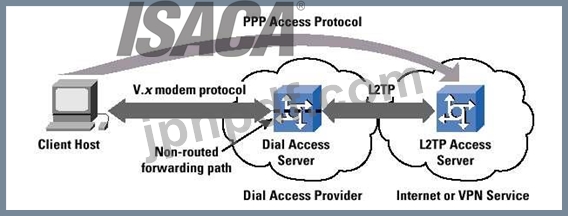
Point-to-point protocol
PPP (Point-to-Point Protocol) is a protocol for communication between two computers using a serial interface, typically a personal computer connected by phone line to a server. For example, your Internet server provider may provide you with a PPP connection so that the provider's server can respond to your requests, pass them on to the Internet, and forward your requested Internet responses back to you.
PPP uses the Internet protocol (IP) (and is designed to handle other protocol as well). It is sometimes considered a member of the TCP/IP suite of protocols. Relative to the Open Systems Interconnection (OSI) reference model, PPP provides layer 2 (data-link layer) service. Essentially, it packages your computer's TCP/IP packets and forwards them to the server where they can actually be put on the Internet.
PPP is a full-duplex protocol that can be used on various physical media, including twisted pair or fiber optic lines or satellite transmission. It uses a variation of High Speed Data Link Control (HDLC) for packet encapsulation.
PPP is usually preferred over the earlier de facto standard Serial Line Internet Protocol (SLIP) because it can handle synchronous as well as asynchronous communication. PPP can share a line with other users and it has error detection that SLIP lacks. Where a choice is possible, PPP is preferred.
Point-to-point protocol
X.25
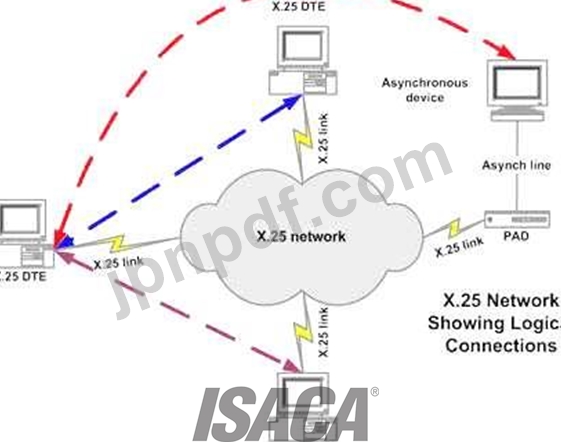
X.25は、パケット交換広域ネットワーク(WAN)通信のためのITU-T標準プロトコルスイートです。
X.25は、キャリアスイッチを使用してさまざまなネットワークへの接続を提供するパケット交換技術です。
加入者は使用する帯域幅の量に基づいて料金を請求されます。データは128バイトに分割され、高レベルデータリンク制御(HDLC)でカプセル化されます。
X.25はOSIモデルのネットワーク層とデータリンク層で動作します。
X.25
フレームリレー
パケット交換として機能します
OSIモデルのデータリンク層で動作します。
より高いレベルの帯域幅が常に利用可能であることを保証するために、より多くの料金を支払う企業は、コミットメント情報レート(CIR)を支払います。フレームリレーでは主に2種類の機器が使用されます。
1. データ端末装置(DTE) - 通常は顧客所有のデバイスで、企業のネットワークとフレームリレーのネットワーク間の接続を提供します。
2. データ回線端末装置(DCE) -フレームリレークラウド内で実際のデータ伝送とスイッチングを行うサービスプロバイダのデバイス。
フレームリレークラウドは、スイッチング機能とデータ通信機能を提供するDCE(データセンターエクスチェンジ)の集合体です。フレームリレーは、あらゆるサービス間の通信を可能にします。
フレームリレー
統合サービスデジタルネットワーク(ISDN)
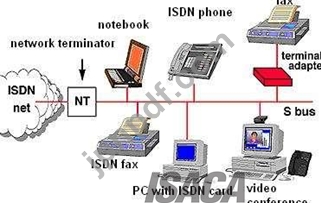
データ、音声、その他の種類のトラフィックを、従来アナログ音声伝送にのみ使用されていた媒体上でデジタル方式で伝送することを可能にする。
従来の電話回線(POTS)上で動作します。同じ銅製の電話線が使用されます。
デジタルポイントツーポイント回線交換媒体を提供する。
ISDN
非同期転送モード(ATM)
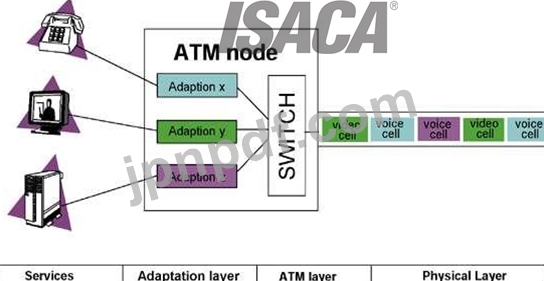
セルスイッチング方式を採用
LAN、MAN、WANで使用される高速ネットワーク技術
フレームリレーと同様に、これは接続指向の技術であり、固定チャネルを作成して使用します。データは53バイトの固定サイズのセルに分割されます。一部の企業はFDDIバックエンドをATM非同期転送モードに置き換えています。
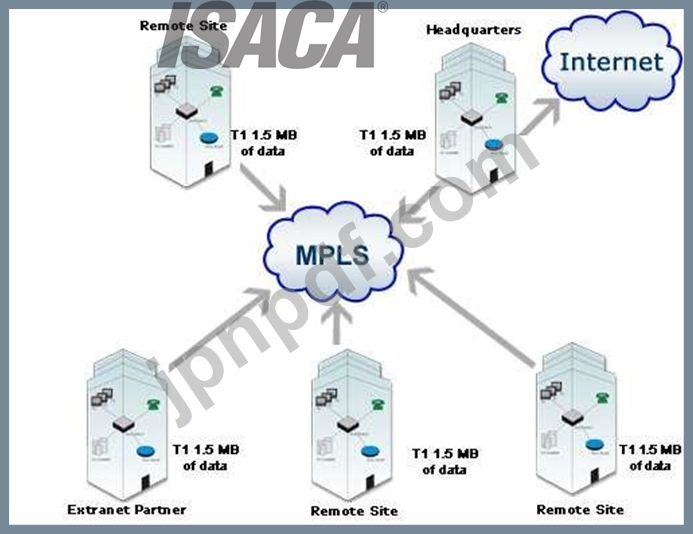
マルチプロトコルラベルスイッチング(MPLS)
マルチプロトコルラベルスイッチング(MPLS)は、ネットワークトラフィックの流れを高速化し、管理を容易にするための標準規格に準拠した技術です。MPLSでは、各パケットにラベルを付けることで、特定のパケットシーケンスに対して専用のパスを設定します。これにより、ルーターがパケットを転送する次のノードのアドレスを検索するのに必要な時間を節約できます。
MPLSは、インターネットプロトコル(IP)、非同期トランスポートモード(ATM)、およびフレームリレーネットワークプロトコルと連携して動作するため、マルチプロトコルと呼ばれています。
OSI(Open Systems Interconnection)モデルを参照すると、MPLSでは、ほとんどのパケットをレイヤ3(ルーティング)レベルではなく、レイヤ2(スイッチング)レベルで転送することができます。
In addition to moving traffic faster overall, MPLS makes it easy to manage a network for quality of service (QoS). For these reasons, the technique is expected to be readily adopted as networks begin to carry more and different mixtures of traffic.
MPLS
The following answers are incorrect:
DCE - Data Circuit Terminal Equipment (DCE) is a service provider device that does the actual data transmission and switching in the frame relay cloud.
DME - Not a valid frame relay technique
DLE - Not a valid frame relay technique
Reference:
CISA review manual 2014 page number 266

