Eradication is a step in the incident response process that involves removing any traces or remnants of the incident from the affected systems or networks, such as malware, backdoors, compromised accounts, or malicious files. Eradication also involves restoring the systems or networks to their normal or secure state, as well as verifying that the incident is completely eliminated and cannot recur. In this case, the analyst is remediating items associated with a recent incident by isolating the vulnerability and actively removing it from the system. This describes the eradication step of the incident response process.
Application security scanning is a process that involves testing and analyzing applications for security vulnerabilities, such as injection flaws, broken authentication, cross-site scripting, and insecure configuration. Application security scanning can help identify and fix security issues before they become exploitable by attackers. Using application security scanning as part of the pipeline for the continuous integration/continuous delivery (CI/CD) flow can help mitigate the problem of finding the same vulnerabilities in a critical application during security scanning. This is because application security scanning can be integrated into the development lifecycle and performed automatically and frequently as part of the CI/CD process.
Implementing a central place to manage IT assets is the best solution to decrease the inconsistencies regarding versions and patches in the existing infrastructure. A central place to manage IT assets, such as a configuration management database (CMDB), can help the vulnerability assessment team to have an accurate and up-to-date inventory of all the hardware and software components in the network, as well as their relationships and dependencies. A CMDB can also track the changes and updates made to the IT assets, and provide a single source of truth for the vulnerability assessment team and other teams to compare and verify the versions and patches of the infrastructure12. Implementing credentialed scanning, changing from a passive to an active scanning approach, and performing agentless scanning are all methods to improve the vulnerability scanning process, but they do not address the root cause of the inconsistencies, which is the lack of a central place to manage IT assets3. References: What is a Configuration Management Database (CMDB)?, How to Use a CMDB to Improve Vulnerability Management, Vulnerability Scanning Best Practices
CS0-003J 試験問題 64
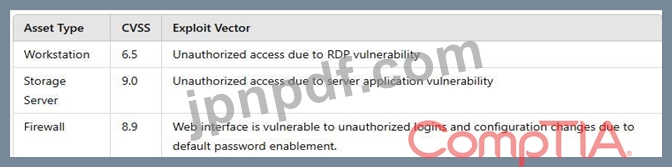
脆弱性スキャンにより、環境内に次の脆弱性が見つかりました。 同時に、次のセキュリティアドバイザリがリリースされました。 「CVSS スコア 10 のゼロデイ脆弱性が Web サーバーに影響を及ぼしている可能性があります。ベンダーはパッチまたは回避策に取り組んでいます。」セキュリティ アナリストが最初に実行する必要があるアクションは次のうちどれですか。
正解: A
In this scenario, the security analyst is presented with multiple vulnerabilities, including a critical zero-day vulnerability affecting the web server with a CVSS score of 10. The CVSS (Common Vulnerability Scoring System) provides a standardized method for rating IT vulnerabilities, with a score of 10 indicating the highest severity. Option A:Contact the web systems administrator and request that they shut down the asset. * Correct Choice:Given the critical nature of a zero-day vulnerability with a CVSS score of 10, immediate action is warranted to prevent potential exploitation. Shutting down the affected web server reduces the attack surface and mitigates the risk until a patch or workaround is available. This aligns with incident response best practices, where containment is a priority to prevent further damage. Option B:Monitor the patch releases for all items and escalate patching to the appropriate team. * Incorrect Choice:While monitoring for patches is essential, it is a reactive approach. In the case of a zero-day vulnerability with active exploitation potential, waiting for a patch without implementing immediate protective measures exposes the organization to significant risk. Option C:Run the vulnerability scan again to verify the presence of the critical finding and the zero-day vulnerability in the environment. * Incorrect Choice:Re-scanning may confirm the vulnerability's presence but does not address the immediate threat. Action to mitigate the risk should take precedence over verification, especially when the vulnerability is known and critical. Option D:Forward the advisory to the web security team and initiate the prioritization strategy for the other vulnerabilities. * Incorrect Choice:Communicating with the web security team is important; however, in the face of a critical zero-day vulnerability, immediate action (such as shutting down the affected asset) is necessary before addressing other vulnerabilities.
Data exfiltration is the theft or unauthorized transfer or movement of data from a device or network. It can occur as part of an automated attack or manually, on-site or through an internet connection, and involve various methods. It can affect personal or corporate data, such as sensitive or confidential information. Data exfiltration can be prevented or detected by using compression, encryption, authentication, authorization, and other controls1 The network activity shows that a device on the network is sending an outbound email via a mail client to a non-company email address daily at 10:00 p.m. This could indicate that the device is compromised by malware or an insider threat, and that the email is used to exfiltrate data from the network to an external party. The email could contain attachments, links, or hidden data that contain the stolen information. The timing of the email could be designed to avoid detection by normal network monitoring or security systems.