Importance of Measuring Performance & Performance Measurement Tool
Introduction
Performance measurement is essential for organizations to evaluate their efficiency, effectiveness, and strategic success. It provides quantifiable insights into business operations, helping companies make data-driven decisions, improve productivity, and maintain competitive advantage.
To achieve this, organizations use various performance measurement tools. One widely used tool is the Balanced Scorecard (BSC), which provides a holistic approach to measuring performance across different business areas.
1. Importance of Measuring Performance
Organizations must measure performance to achieve the following benefits:
1.1 Supports Strategic Decision-Making
✅ Helps businesses align operations with strategic goals.
✅ Identifies areas needing improvement or investment.
Example: A company analyzing supply chain delays can make informed decisions on sourcing alternative suppliers.
1.2 Improves Efficiency and Productivity
✅ Tracks operational effectiveness to reduce waste and costs.
✅ Ensures departments meet KPIs (Key Performance Indicators).
Example: A manufacturer measuring production efficiency can identify bottlenecks and streamline processes.
1.3 Enhances Customer Satisfaction and Quality Control
✅ Monitoring performance ensures high product/service quality.
✅ Helps companies respond to customer expectations and feedback.
Example: A retail company tracking customer complaint resolution times can improve customer service.
1.4 Ensures Financial Stability and Profitability
✅ Measures profit margins, cost efficiency, and revenue growth.
✅ Assists in budgeting and financial planning.
Example: A business monitoring cash flow and profitability ratios can detect financial risks early.
1.5 Supports Continuous Improvement and Benchmarking
✅ Allows companies to compare their performance with competitors.
✅ Encourages a culture of continuous improvement.
Example: A company benchmarking its sustainability metrics against industry leaders can enhance CSR strategies.
2. Performance Measurement Tool - The Balanced Scorecard (BSC)
One widely used performance measurement tool is the Balanced Scorecard (BSC).
2.1 Explanation of the Balanced Scorecard
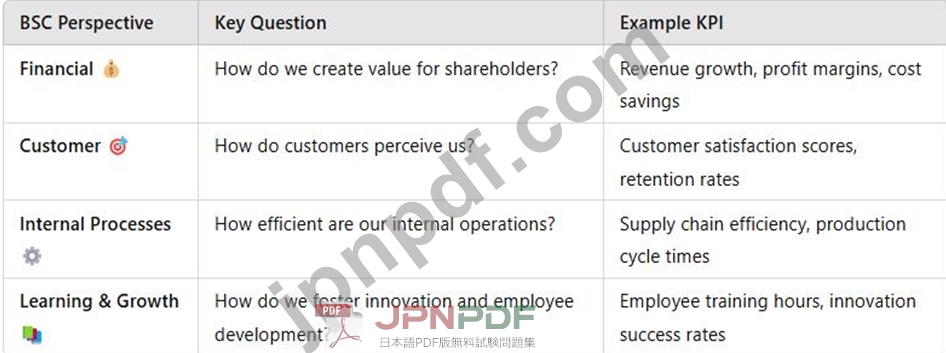
The Balanced Scorecard (BSC), developed by Kaplan and Norton, measures performance across four key perspectives:
2.2 Application of BSC in Performance Measurement
✅ Holistic View: Measures financial and non-financial performance.
✅ Strategic Alignment: Ensures all departments contribute to business goals.
✅ Data-Driven Decision-Making: Provides insights for process improvements and competitive positioning.
Example:
A logistics company implementing BSC could track:
Financial: Cost per delivery
Customer: Delivery accuracy and satisfaction scores
Internal Processes: Warehouse efficiency
Learning & Growth: Employee training on automation tools
3. Advantages and Limitations of the Balanced Scorecard
✅ Advantages
✔ Aligns performance measurement with business strategy.
✔ Ensures balanced focus across financial and operational areas.
✔ Encourages continuous improvement through KPI tracking.
❌ Limitations
✖ Can be complex and time-consuming to implement.
✖ Needs regular updates to remain relevant.
✖ May require cultural change for adoption across all departments.
Conclusion
Measuring performance is essential for strategic decision-making, operational efficiency, customer satisfaction, financial stability, and continuous improvement. The Balanced Scorecard (BSC) is a powerful tool that provides a comprehensive performance assessment, helping organizations maintain a sustainable competitive advantage.

