

SSCP 試験問題 21
As per RFC 1122, which of the following is not a defined layer in the DoD TCP/IP protocol model?
正解: B
As per RFC, The DoD TCP/IP protocol model defines four layers, with the
layers having names, not numbers, as follows:
Application (process-to-process) Layer:
This is the scope within which applications create user data and communicate this data to
other processes or applications on another or the same host. The communications partners
are often called peers. This is where the "higher level" protocols such as SMTP, FTP, SSH,
HTTP, etc. operate.
Transport (host-to-host) Layer:
The Transport Layer constitutes the networking regime between two network hosts, either
on the local network or on remote networks separated by routers. The Transport Layer
provides a uniform networking interface that hides the actual topology (layout) of the
underlying network connections. This is where flow-control, error-correction, and
connection protocols exist, such as TCP. This layer deals with opening and maintaining
connections between internet hosts.
Internet (internetworking) Layer:
The Internet Layer has the task of exchanging datagrams across network boundaries. It is
therefore also referred to as the layer that establishes internetworking; indeed, it defines
and establishes the Internet. This layer defines the addressing and routing structures used
for the TCP/IP protocol suite. The primary protocol in this scope is the Internet Protocol,
which defines IP addresses. Its function in routing is to transport datagrams to the next IP
router that has the connectivity to a network closer to the final data destination.
Link (network access) Layer: This layer defines the networking methods with the scope of the local network link on which hosts communicate without intervening routers. This layer describes the protocols used to describe the local network topology and the interfaces needed to affect transmission of Internet Layer datagrams to next-neighbor hosts.
The DoD tcp/ip model DoD model Osi Model

Graphic above from: http://bit.kuas.edu.tw/
REALITY VERSUS THE STANDARD In real life today, this is getting very confusing. Many books and references will not use exactly the same names as the initial RFC that was published. For example, the Link layer is often times called Network Access. The same applies with Transport which is often times called Host-to-Host and vice versa.
The following answer is incorrect: The session layer is defined within the OSI/ISO model but not within the DOD model. Being incorrect it made it the best answer according to the question. It does not belong to the DoD TCP/IP Model.
Reference(s) Used for this question:
http://www.freesoft.org/CIE/RFC/1122/ http://bit.kuas.edu.tw/~csshieh/teach/np/tcpip/
layers having names, not numbers, as follows:
Application (process-to-process) Layer:
This is the scope within which applications create user data and communicate this data to
other processes or applications on another or the same host. The communications partners
are often called peers. This is where the "higher level" protocols such as SMTP, FTP, SSH,
HTTP, etc. operate.
Transport (host-to-host) Layer:
The Transport Layer constitutes the networking regime between two network hosts, either
on the local network or on remote networks separated by routers. The Transport Layer
provides a uniform networking interface that hides the actual topology (layout) of the
underlying network connections. This is where flow-control, error-correction, and
connection protocols exist, such as TCP. This layer deals with opening and maintaining
connections between internet hosts.
Internet (internetworking) Layer:
The Internet Layer has the task of exchanging datagrams across network boundaries. It is
therefore also referred to as the layer that establishes internetworking; indeed, it defines
and establishes the Internet. This layer defines the addressing and routing structures used
for the TCP/IP protocol suite. The primary protocol in this scope is the Internet Protocol,
which defines IP addresses. Its function in routing is to transport datagrams to the next IP
router that has the connectivity to a network closer to the final data destination.
Link (network access) Layer: This layer defines the networking methods with the scope of the local network link on which hosts communicate without intervening routers. This layer describes the protocols used to describe the local network topology and the interfaces needed to affect transmission of Internet Layer datagrams to next-neighbor hosts.
The DoD tcp/ip model DoD model Osi Model
Graphic above from: http://bit.kuas.edu.tw/
REALITY VERSUS THE STANDARD In real life today, this is getting very confusing. Many books and references will not use exactly the same names as the initial RFC that was published. For example, the Link layer is often times called Network Access. The same applies with Transport which is often times called Host-to-Host and vice versa.
The following answer is incorrect: The session layer is defined within the OSI/ISO model but not within the DOD model. Being incorrect it made it the best answer according to the question. It does not belong to the DoD TCP/IP Model.
Reference(s) Used for this question:
http://www.freesoft.org/CIE/RFC/1122/ http://bit.kuas.edu.tw/~csshieh/teach/np/tcpip/
SSCP 試験問題 22
What refers to legitimate users accessing networked services that would normally be restricted to them?
正解: D
Section: Access Control
Explanation/Reference:
Unauthorized access of restricted network services by the circumvention of security access controls is known as logon abuse. This type of abuse refers to users who may be internal to the network but access resources they would not normally be allowed.
Source: KRUTZ, Ronald L. & VINES, Russel D., The CISSP Prep Guide: Mastering the Ten Domains of Computer Security, John Wiley & Sons, 2001, Chapter 3: Telecommunications and Network Security (page
74).
Explanation/Reference:
Unauthorized access of restricted network services by the circumvention of security access controls is known as logon abuse. This type of abuse refers to users who may be internal to the network but access resources they would not normally be allowed.
Source: KRUTZ, Ronald L. & VINES, Russel D., The CISSP Prep Guide: Mastering the Ten Domains of Computer Security, John Wiley & Sons, 2001, Chapter 3: Telecommunications and Network Security (page
74).
SSCP 試験問題 23
Compared to RSA, which of the following is true of Elliptic Curve Cryptography(ECC)?
正解: D
Explanation/Reference:
The following answers are incorrect: It has been mathematically proved to be less secure. ECC has not been proved to be more or less secure than RSA. Since ECC is newer than RSA, it is considered riskier by some, but that is just a general assessment, not based on mathematical arguments.
It has been mathematically proved to be more secure. ECC has not been proved to be more or less secure than RSA. Since ECC is newer than RSA, it is considered riskier by some, but that is just a general assessment, not based on mathematical arguments.
It is believed to require longer key for equivalent security. On the contrary, it is believed to require shorter keys for equivalent security of RSA.
Shon Harris, AIO v5 pg719 states:
"In most cases, the longer the key, the more protection that is provided, but ECC can provide the same level of protection with a key size that is shorter that what RSA requires" The following reference(s) were/was used to create this question:
ISC2 OIG, 2007 p. 258
Shon Harris, AIO v5 pg719
The following answers are incorrect: It has been mathematically proved to be less secure. ECC has not been proved to be more or less secure than RSA. Since ECC is newer than RSA, it is considered riskier by some, but that is just a general assessment, not based on mathematical arguments.
It has been mathematically proved to be more secure. ECC has not been proved to be more or less secure than RSA. Since ECC is newer than RSA, it is considered riskier by some, but that is just a general assessment, not based on mathematical arguments.
It is believed to require longer key for equivalent security. On the contrary, it is believed to require shorter keys for equivalent security of RSA.
Shon Harris, AIO v5 pg719 states:
"In most cases, the longer the key, the more protection that is provided, but ECC can provide the same level of protection with a key size that is shorter that what RSA requires" The following reference(s) were/was used to create this question:
ISC2 OIG, 2007 p. 258
Shon Harris, AIO v5 pg719
SSCP 試験問題 24
Which of the following phases of a software development life cycle normally incorporates the security specifications, determines access controls, and evaluates encryption options?
正解: C
During the Functional Requirements Definition the project management and systems development teams will conduct a comprehensive analysis of current and possible future functional requirements to ensure that the new system will meet end-user needs. The teams also review the documents from the project initiation phase and make any revisions or updates as needed. For smaller projects, this phase is often subsumed in the project initiation phase. At this point security requirements should be formalized.
The Development Life Cycle is a project management tool that can be used to plan, execute, and control a software development project usually called the Systems Development Life Cycle (SDLC).
The SDLC is a process that includes systems analysts, software engineers, programmers, and end users in the project design and development. Because there is no industry-wide SDLC, an organization can use any one, or a combination of SDLC methods.
The SDLC simply provides a framework for the phases of a software development project from defining the functional requirements to implementation. Regardless of the method used, the SDLC outlines the essential phases, which can be shown together or as separate elements. The model chosen should be based on the project.
For example, some models work better with long-term, complex projects, while others are more suited for short-term projects. The key element is that a formalized SDLC is utilized.
The number of phases can range from three basic phases (concept, design, and implement) on up.
The basic phases of SDLC are:
Project initiation and planning Functional requirements definition System design specifications Development and implementation Documentation and common program controls Testing and evaluation control, (certification and accreditation) Transition to production (implementation)
The system life cycle (SLC) extends beyond the SDLC to include two additional phases:
Operations and maintenance support (post-installation) Revisions and system replacement
System Design Specifications This phase includes all activities related to designing the system and software. In this phase, the system architecture, system outputs, and system interfaces are designed. Data input, data flow, and output requirements are established and security features are designed, generally based on the overall security architecture for the company.
Development and Implementation During this phase, the source code is generated, test scenarios and test cases are developed, unit and integration testing is conducted, and the program and system are documented for maintenance and for turnover to acceptance testing and production. As well as general care for software quality, reliability, and consistency of operation, particular care should be taken to ensure that the code is analyzed to eliminate common vulnerabilities that might lead to security exploits and other risks.
Documentation and Common Program Controls These are controls used when editing the data within the program, the types of logging the program should be doing, and how the program versions should be stored. A large number of such controls may be needed, see the reference below for a full list of controls.
Acceptance In the acceptance phase, preferably an independent group develops test data and tests the code to ensure that it will function within the organization's environment and that it meets all the functional and security requirements. It is essential that an independent group test the code during all applicable stages of development to prevent a separation of duties issue. The goal of security testing is to ensure that the application meets its security requirements and specifications. The security testing should uncover all design and implementation flaws that would allow a user to violate the software security policy and requirements. To ensure test validity, the application should be tested in an environment that simulates the production environment. This should include a security certification package and any user documentation.
Certification and Accreditation (Security Authorization) Certification is the process of evaluating the security stance of the software or system against a predetermined set of security standards or policies. Certification also examines how well the system performs its intended functional requirements. The certification or evaluation document should contain an analysis of the technical and nontechnical security features and countermeasures and the extent to which the software or system meets the security requirements for its mission and operational environment.
Transition to Production (Implementation) During this phase, the new system is transitioned from the acceptance phase into the live production environment. Activities during this phase include obtaining security accreditation; training the new users according to the implementation and training schedules; implementing the system, including installation and data conversions; and, if necessary, conducting any parallel operations.
Revisions and System Replacement As systems are in production mode, the hardware and software baselines should be subject to periodic evaluations and audits. In some instances, problems with the application may not be defects or flaws, but rather additional functions not currently developed in the application. Any changes to the application must follow the same SDLC and be recorded in a change management system. Revision reviews should include security planning and procedures to avoid future problems. Periodic application audits should be conducted and include documenting security incidents when problems occur. Documenting system failures is a valuable resource for justifying future system enhancements.
Below you have the phases used by NIST in it's 800-63 Revision 2 document
As noted above, the phases will vary from one document to another one. For the purpose
of the exam use the list provided in the official ISC2 Study book which is presented in short
form above. Refer to the book for a more detailed description of activities at each of the
phases of the SDLC.
However, all references have very similar steps being used. As mentioned in the official
book, it could be as simple as three phases in it's most basic version (concept, design, and
implement) or a lot more in more detailed versions of the SDLC.
The key thing is to make use of an SDLC.
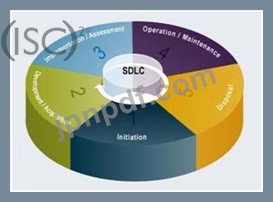
SDLC phases
Reference(s) used for this question:
NIST SP 800-64 Revision 2 at http://csrc.nist.gov/publications/nistpubs/800-64Rev2/SP800-64-Revision2.pdf and Schneiter, Andrew (2013-04-15). Official (ISC)2 Guide to the CISSP CBK, Third Edition: Software Development Security ((ISC)2 Press) (Kindle Locations 134-157). Auerbach Publications. Kindle Edition.
The Development Life Cycle is a project management tool that can be used to plan, execute, and control a software development project usually called the Systems Development Life Cycle (SDLC).
The SDLC is a process that includes systems analysts, software engineers, programmers, and end users in the project design and development. Because there is no industry-wide SDLC, an organization can use any one, or a combination of SDLC methods.
The SDLC simply provides a framework for the phases of a software development project from defining the functional requirements to implementation. Regardless of the method used, the SDLC outlines the essential phases, which can be shown together or as separate elements. The model chosen should be based on the project.
For example, some models work better with long-term, complex projects, while others are more suited for short-term projects. The key element is that a formalized SDLC is utilized.
The number of phases can range from three basic phases (concept, design, and implement) on up.
The basic phases of SDLC are:
Project initiation and planning Functional requirements definition System design specifications Development and implementation Documentation and common program controls Testing and evaluation control, (certification and accreditation) Transition to production (implementation)
The system life cycle (SLC) extends beyond the SDLC to include two additional phases:
Operations and maintenance support (post-installation) Revisions and system replacement
System Design Specifications This phase includes all activities related to designing the system and software. In this phase, the system architecture, system outputs, and system interfaces are designed. Data input, data flow, and output requirements are established and security features are designed, generally based on the overall security architecture for the company.
Development and Implementation During this phase, the source code is generated, test scenarios and test cases are developed, unit and integration testing is conducted, and the program and system are documented for maintenance and for turnover to acceptance testing and production. As well as general care for software quality, reliability, and consistency of operation, particular care should be taken to ensure that the code is analyzed to eliminate common vulnerabilities that might lead to security exploits and other risks.
Documentation and Common Program Controls These are controls used when editing the data within the program, the types of logging the program should be doing, and how the program versions should be stored. A large number of such controls may be needed, see the reference below for a full list of controls.
Acceptance In the acceptance phase, preferably an independent group develops test data and tests the code to ensure that it will function within the organization's environment and that it meets all the functional and security requirements. It is essential that an independent group test the code during all applicable stages of development to prevent a separation of duties issue. The goal of security testing is to ensure that the application meets its security requirements and specifications. The security testing should uncover all design and implementation flaws that would allow a user to violate the software security policy and requirements. To ensure test validity, the application should be tested in an environment that simulates the production environment. This should include a security certification package and any user documentation.
Certification and Accreditation (Security Authorization) Certification is the process of evaluating the security stance of the software or system against a predetermined set of security standards or policies. Certification also examines how well the system performs its intended functional requirements. The certification or evaluation document should contain an analysis of the technical and nontechnical security features and countermeasures and the extent to which the software or system meets the security requirements for its mission and operational environment.
Transition to Production (Implementation) During this phase, the new system is transitioned from the acceptance phase into the live production environment. Activities during this phase include obtaining security accreditation; training the new users according to the implementation and training schedules; implementing the system, including installation and data conversions; and, if necessary, conducting any parallel operations.
Revisions and System Replacement As systems are in production mode, the hardware and software baselines should be subject to periodic evaluations and audits. In some instances, problems with the application may not be defects or flaws, but rather additional functions not currently developed in the application. Any changes to the application must follow the same SDLC and be recorded in a change management system. Revision reviews should include security planning and procedures to avoid future problems. Periodic application audits should be conducted and include documenting security incidents when problems occur. Documenting system failures is a valuable resource for justifying future system enhancements.
Below you have the phases used by NIST in it's 800-63 Revision 2 document
As noted above, the phases will vary from one document to another one. For the purpose
of the exam use the list provided in the official ISC2 Study book which is presented in short
form above. Refer to the book for a more detailed description of activities at each of the
phases of the SDLC.
However, all references have very similar steps being used. As mentioned in the official
book, it could be as simple as three phases in it's most basic version (concept, design, and
implement) or a lot more in more detailed versions of the SDLC.
The key thing is to make use of an SDLC.
SDLC phases
Reference(s) used for this question:
NIST SP 800-64 Revision 2 at http://csrc.nist.gov/publications/nistpubs/800-64Rev2/SP800-64-Revision2.pdf and Schneiter, Andrew (2013-04-15). Official (ISC)2 Guide to the CISSP CBK, Third Edition: Software Development Security ((ISC)2 Press) (Kindle Locations 134-157). Auerbach Publications. Kindle Edition.
SSCP 試験問題 25
What can best be defined as a strongly protected computer that is in a network protected by a firewall (or is part of a firewall) and is the only host (or one of only a few hosts) in the network that can be directly accessed from networks on the other side of the firewall?
正解: A
The Internet Security Glossary (RFC2828) defines a bastion host as a strongly protected computer that is in a network protected by a firewall (or is part of a firewall) and is the only host (or one of only a few hosts) in the network that can be directly accessed from networks on the other side of the firewall. Source: SHIREY, Robert W., RFC2828: Internet Security Glossary, may 2000.
- 最新アップロード
- 174Microsoft.AI-103.v2026-10-18.q97
- 146F5.F5CAB4.v2026-10-18.q77
- 194ITIL.ITIL-4-Foundation.v2026-10-18.q130
- 171Fortinet.FCP_FAZ_AN-7.6.v2026-10-18.q74
- 123RedHat.EX280.v2026-10-18.q11
- 258Salesforce.PDI.v2026-10-17.q207
- 207Salesforce.OmniStudio-Developer.v2026-10-17.q130
- 191VMware.6V0-22.25.v2026-10-17.q101
- 186Huawei.H19-401_V2.0.v2026-10-17.q98
- 162LinuxFoundation.PCA.v2026-10-15.q20